
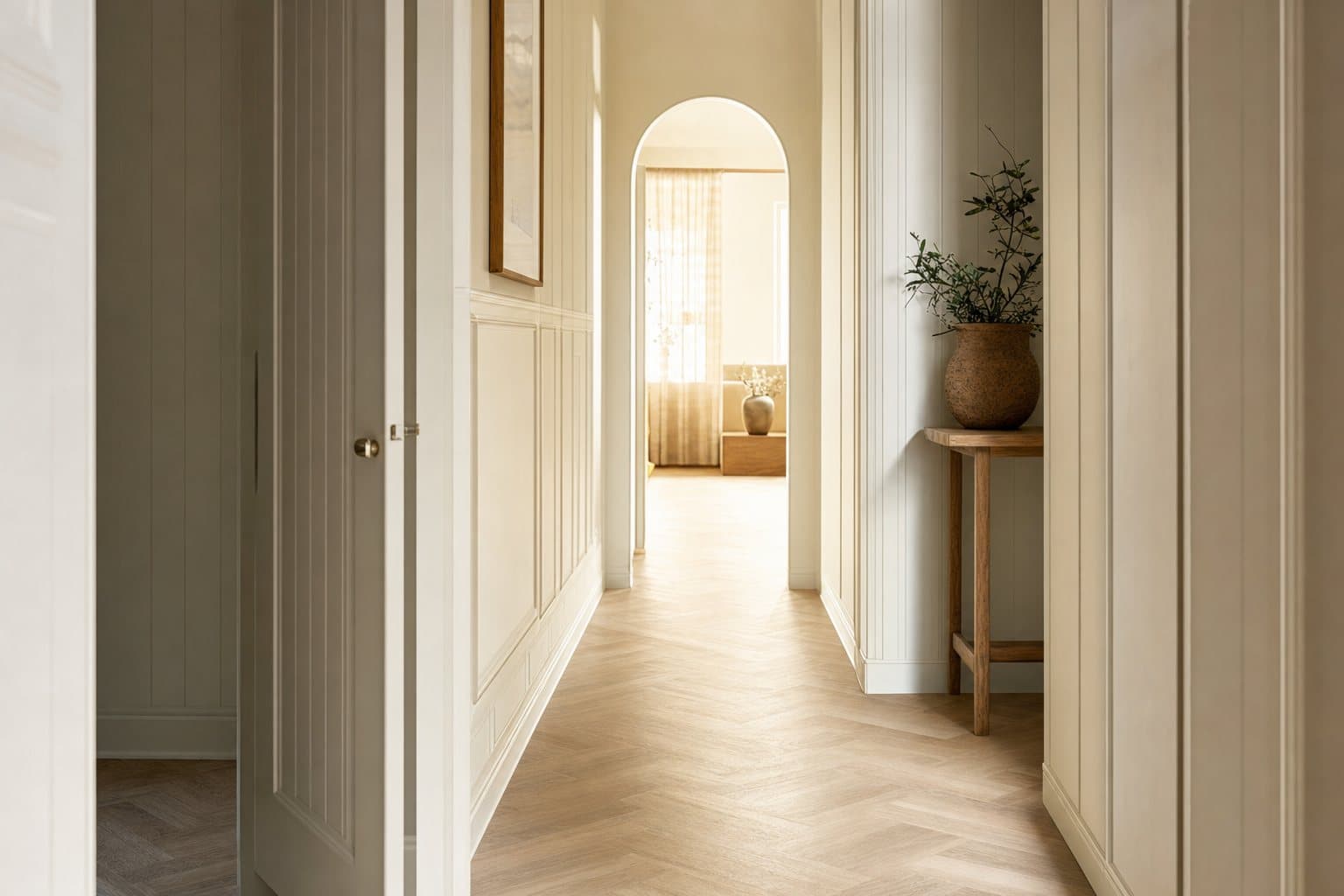
Herringbone Vinyl: A Pattern Guide
Herringbone has moved from Parisian apartments to Brisbane hallways, and vinyl now does the pattern properly. Here is how the pattern works, why pre-formatted planks beat cutting your own, and how to pick a direction and colour for your room.
In this article
Stand in the hallway of a Paris apartment built in the 1850s and the floor under your feet is probably herringbone: short oak boards laid in a repeating zigzag, worn smooth by a century and a half of traffic. The pattern is much older than that. Roman engineers laid bricks in the same arrangement, called opus spicatum, because the interlocking angle spread the load of cart wheels better than straight rows. It made roads that lasted. It also, as it turns out, makes floors that people still want two thousand years later.
Brisbane caught the herringbone bug properly over the last decade, first in engineered oak, then in hybrid and vinyl. And vinyl is where the pattern finally became practical: waterproof, quiet, and a fraction of the cost of cut timber parquetry.
Can Vinyl Plank Be Laid in a Herringbone Pattern?
Yes. People ask us this every week, usually because they have seen the pattern in timber and assumed vinyl only comes in long straight boards. There are two ways to get there. The first is to take standard vinyl planks and cut them down into short lengths yourself, then lay those pieces at ninety degrees to each other. The second is to buy planks that were made for the pattern in the first place: short, narrow boards with factory edges, sized so the zigzag resolves perfectly.
Only one of these is a good idea, and it is not the one with the saw.
Why Pre-Formatted Planks Beat Cutting Your Own
Herringbone is unforgiving. A straight-lay floor hides a wobbly cut inside the field of boards; a herringbone floor puts every joint on display, because the pattern is nothing but joints. Cutting hundreds of standard planks into identical short lengths, each with a clean square end, is slow and difficult even for a patient installer. Every millimetre of variation compounds across the room, and by the far wall the zigzag has drifted visibly out of square.
Cut edges bring a second problem. A factory edge is finished and sealed; a site-cut edge is raw. On a glue-down floor those raw ends still seat fine, but they will never sit as crisply as a machined edge, and in a pattern made entirely of end joints you see the difference everywhere.
There is also the decor itself. Wood grain printed for a 1.5 metre plank looks wrong chopped into 400 millimetre pieces: knots land half on and half off the board, and repeated sections become obvious once dozens of short pieces sit side by side. Pre-formatted herringbone planks are printed at the scale of the short board, so the grain reads correctly and repeats are spread out where you will not spot them.
A herringbone floor is one decision repeated hundreds of times across the room. Pre-formatted planks make every one of those repeats identical.
Which Way Should the Pattern Run?
Herringbone has a direction. The points of the zigzag form arrows, and those arrows should lead somewhere. The convention, and it is a good one, is to run the arrows down the longest sightline in the space: along a hallway, from the entry towards the living room, or towards the main source of natural light. Done this way the pattern stretches the room and pulls the eye through the house.
In an open-plan space with no single obvious axis, pick the direction you see first when you walk in the door and commit to it everywhere. Changing pattern direction between connected rooms almost never looks intentional. One direction, whole floor.
Does Herringbone Suit Small Rooms?
Better than most people expect. Because the boards are short, the pattern reads at a smaller scale than long straight planks, and a small room gains movement and detail instead of being sliced in half by three long boards. Hallways and entries, the smallest floors in the house, are where herringbone earns its keep most reliably.
Two honest cautions. First, a herringbone floor is visually busy, so in a small room keep the rest of the palette calm and lean towards the softer, lower-contrast colours. Second, budget for more offcut waste than a straight lay. Every wall meets the pattern at an angle, and every angled cut throws material away. Your installer or our team can help you land on the right extra allowance for your room shape before you order.
The Herringbone Range We Stock
We carry one herringbone range, and we chose it deliberately: ArtiFloor Premium Herringbone LVT, a waterproof vinyl plank made for the pattern, in eight colours from pale coastal tones through to warmer mid-browns. The boards are pre-formatted for herringbone, so everything above about factory edges and correctly scaled grain applies.
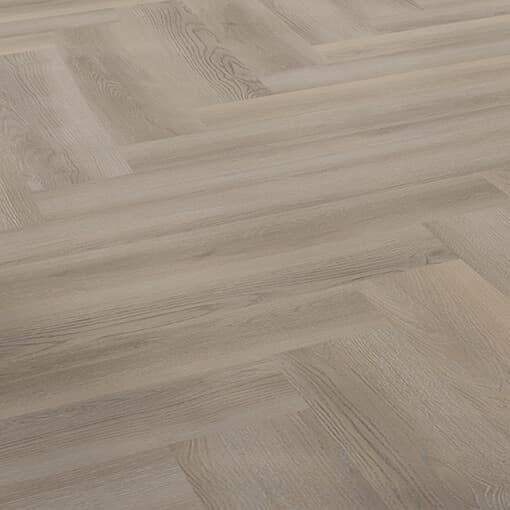
If you are starting a shortlist, Hamptons Haze and Driftwood sit at the lighter end and suit airy, coastal rooms. Sierra Oak and Rustic Path bring more warmth and grain contrast, which reads well in older Queenslanders with timber joinery. You can see all eight colours on the Premium Herringbone range page, and every one of them is available as a sample.
Before You Order
One piece of housekeeping before you order. Setting out matters more with herringbone than with any other floor we stock, because the pattern punishes rushed work. When you brief installers, ask directly whether they have laid pre-formatted herringbone vinyl before, and ask to see a photo of a floor they have done. A good installer will be glad you asked.
- Order samples of two or three colours and look at them in the actual room, at the actual angle the pattern will run.
- Measure the space, then add a generous cutting allowance; herringbone wastes more at the walls than a straight lay.
- Confirm your installer has laid herringbone vinyl before, not just straight plank.
- Keep pattern direction consistent through connected rooms, running towards the longest sightline.
The pattern has survived Roman roads, Parisian apartments and every flooring fashion cycle since. Laid properly, in a colour you have checked in your own light, it will outlast a few more.
Read enough? Hold the floor instead
No article settles a colour decision. Samples are 1 for $15, 2 for $20 or 3 for $25, redeemable against your flooring order, delivered to your door so you can judge the decor in your own light.